
Motion Forword - Words of a Therapist: Head-Bang Fails, Painful Trails, and Shin-Splint Tales
Welcome to Motion Forword - Words of a Therapist! Number 28!

Motion Forword is about discussing the combined benefits of movement with a positive mental attitude. Using my personal/professional experiences, evidence-based research and some of your own experiences.
Bringing some hope, positivity, happiness and maybe usefulness to those, perhaps like yourself, that needs a pick me up.
Something about me…Lessons from Acroyoga
If you have read my blogs before, you know I enjoy Acroyoga.
Acroyoga is a playful way of exploring movement with one or more partners at a time (typically a ‘base’ and a ‘flyer’) combining elements of yoga, acrobatics and gymnastics.
I went to a workshop in Bristol spending a full two days learning new skills and flows (a series of connected poses).
I haven’t been as attentive to my acroyoga of late but still enjoy it none-the-less as it gives me an opportunity to connect with friends and challenge my body in different ways.
Here are some snippets of what we got up to…
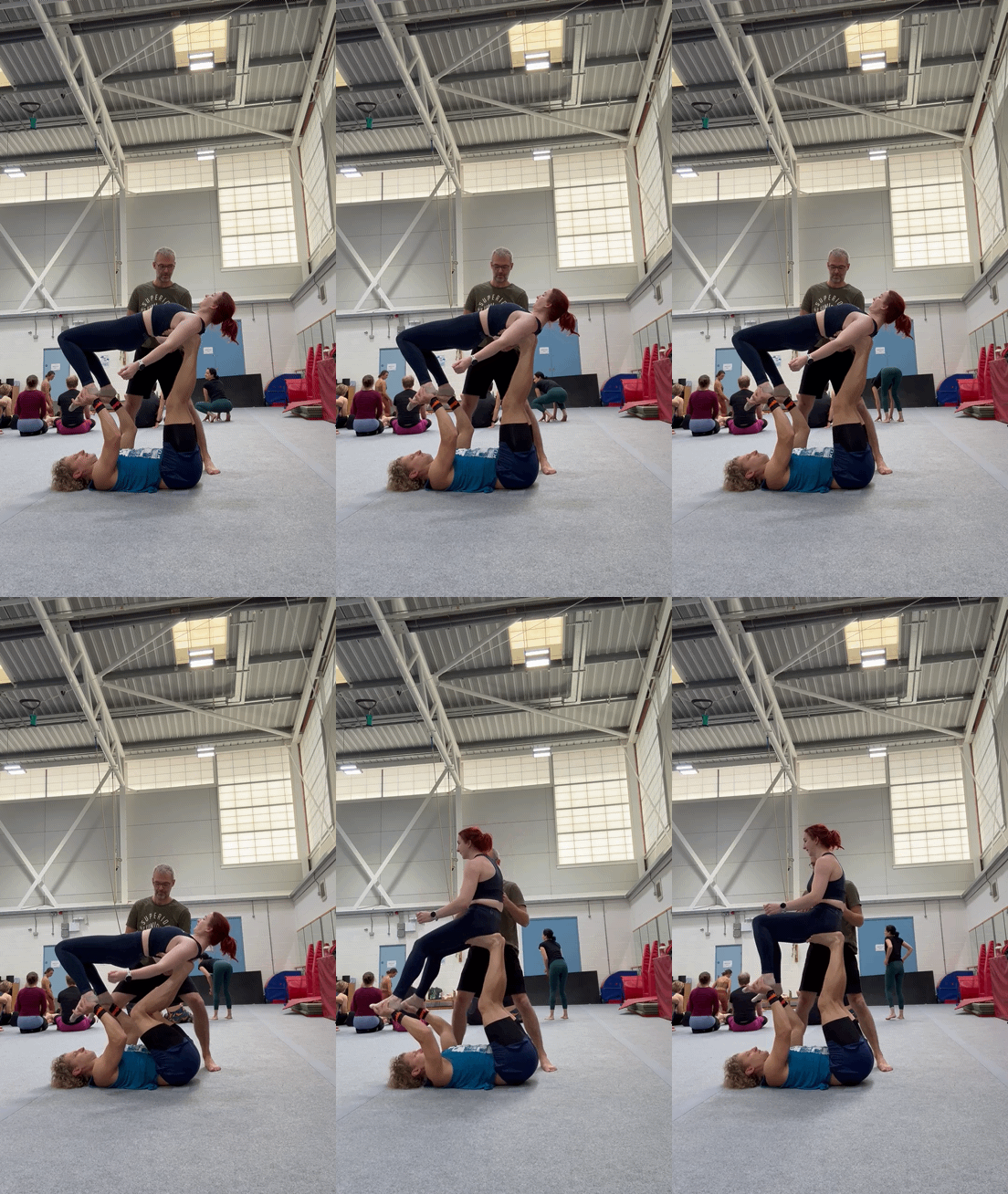
A pop from whale to chair
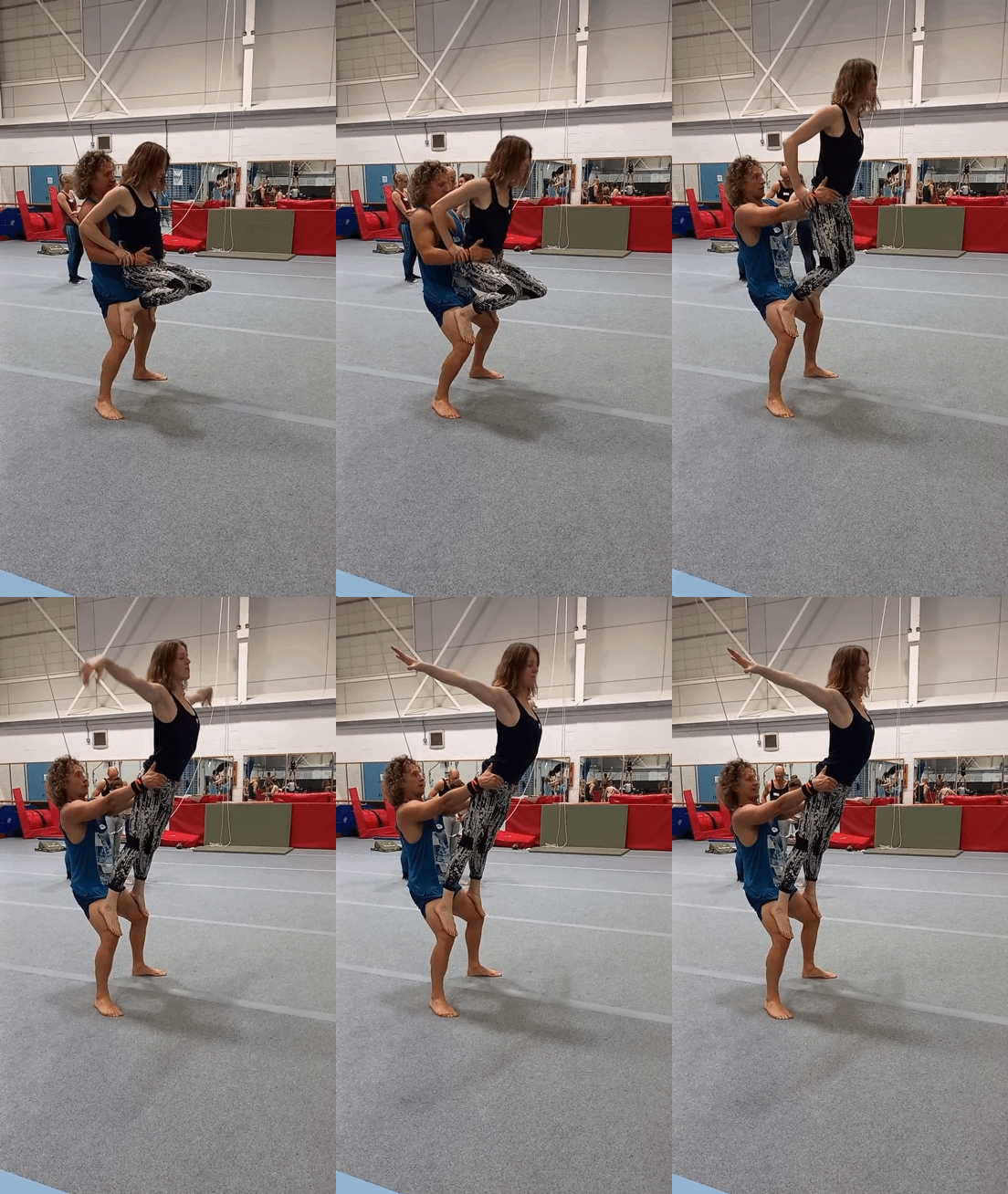
A counter-balance with a smile :)
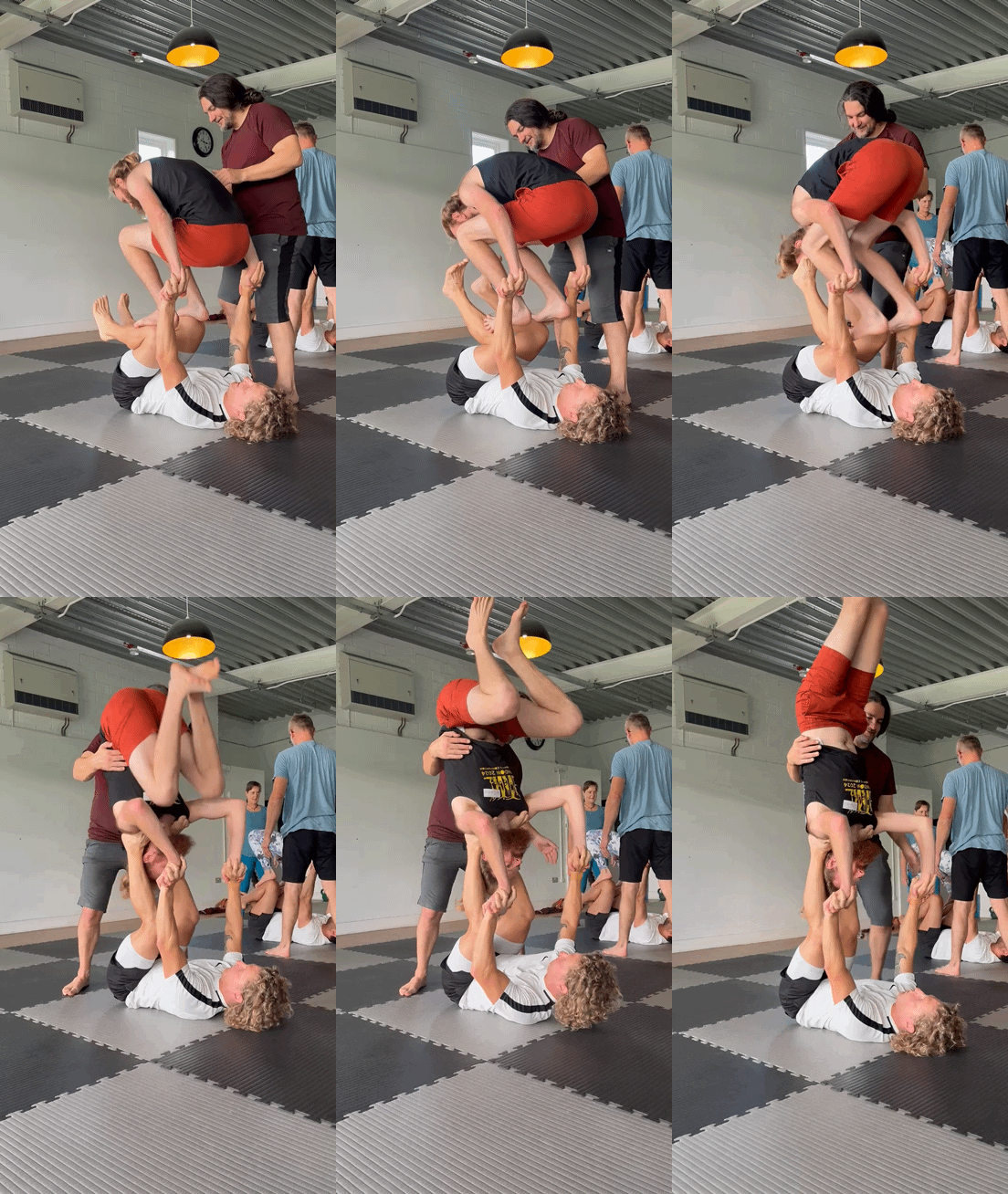
Shin stand to star
Given that it has been a while… I had to pace myself. Two days of throwing, balancing and catching people was tiring!
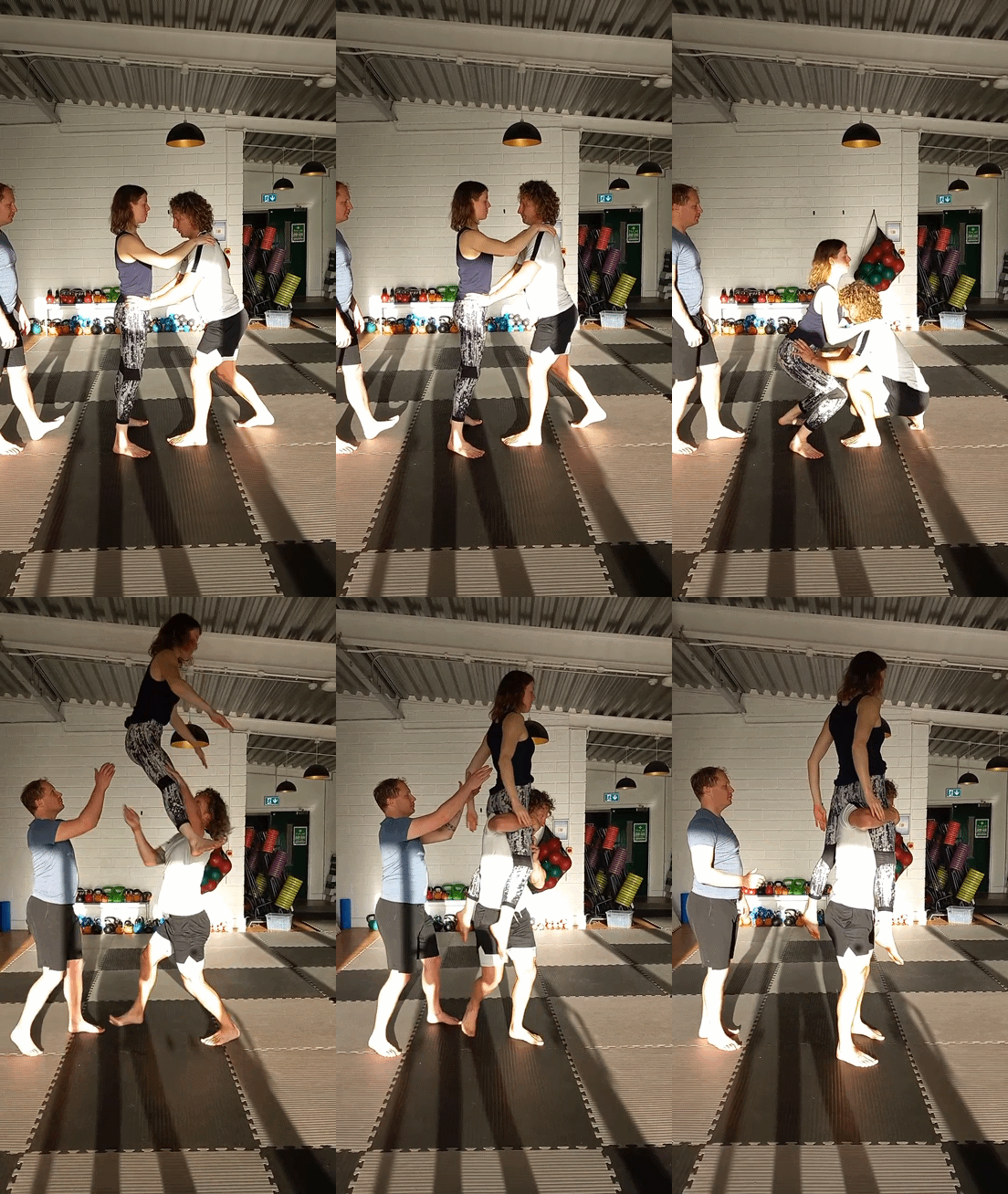
And things can go wrong… like lifting someone and dropping them on your head…
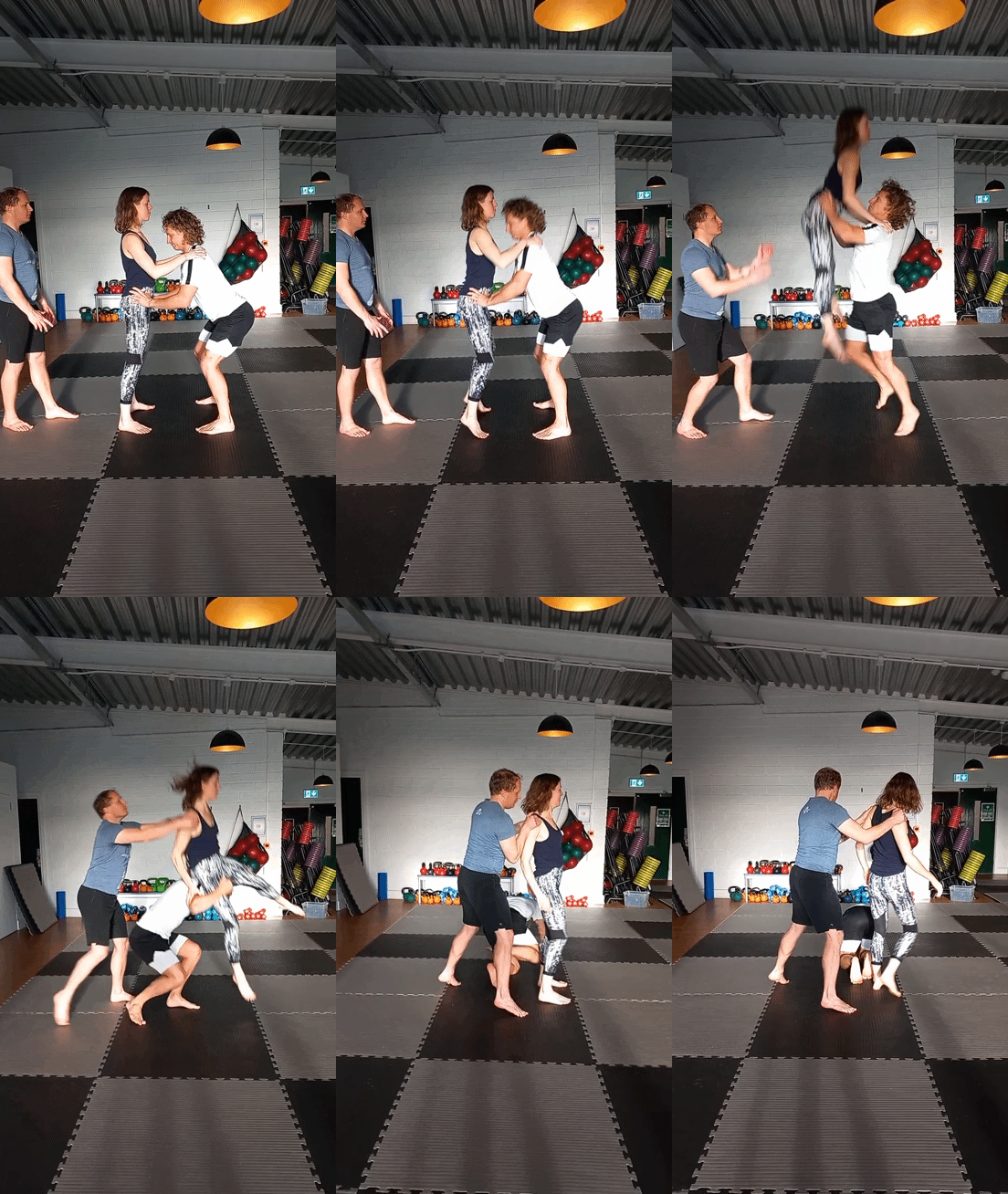
Completely my fault.
Even when done correctly, it is a scary lift as you lose sight of where your flyer is in the air.
I had managed to do this trick almost successfully just before, but in this one, I step too far underneath my flyer and rather than land on my shoulders, all her weight went through my head/neck.
It hurt.
But it was a lesson…
Just before I did this I felt that I was done for the day. I felt physically and mentally tired. I wasn’t as sharp as when I started the day.
I was asked to try it one more time. I said yes, when I should have said no.
I know professionally that when we are physically and mentally drained… that is when mistakes happen and injuries occur (it is why professional sports players get subbed off sooner than we’d like, it is to prevent injury as well as tactical).
So take heed of my mistake…
If you are working out, doing a sport, pushing yourself in your training, doing the gardening, lifting lots of stuff during a move or proactively doing your rehab exercises I’ve given you and you feel tired/out of sorts/unfocused. Take that as your body needs a rest and to save it for another day!
Don’t do what I did, you don’t have to be a hero!
Just to show you how it should be done and prove I did manage to do it the time before…
Something for you…Is it OK to feel Pain with Rehabilitation?
Often when treating my patients we have two general camps of thought:
1. Those who indure pain because they believe it helps (No Pain, No Gain),
and
2. Those that want to avoid pain entirely in fear of it getting worse (Let Pain be your Guide).
Who is right? Whats the best strategy?
This paper by Smith and el, 2017 identified 9 papers that looked at pain rehab protocols compared to no-pain rehab protocols.
They found that 7 of the 9 papers showed a small but significant short-term benefit of encouraging some pain whilst doing exercises compared to pain-free exercises.
However there was no difference by the medium/long-term.
What does this mean?
It doesn’t mean that pain-free exercises are pointless or painful exercises are the only means of rehabiliation.
I think it means that some (a real emphasis on this word!) pain can be helpful when done in a safe and guided way. It offers reassurance to people in pain that not all pain means damage. Changing your mindset around pain in this way helps over come movements or exercises you previously feared. Learning this whilst rehabilitating an injury can be liberating.
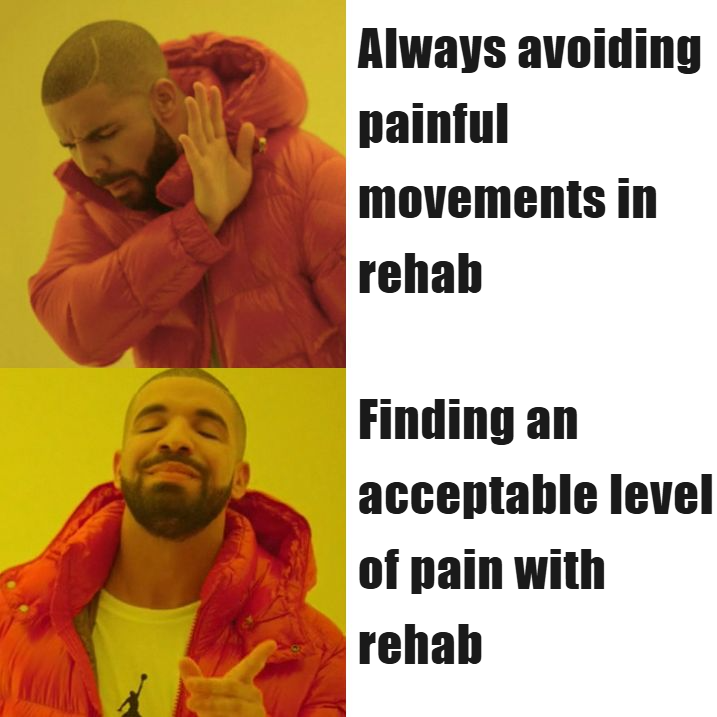
When I treat, I often use the words: Is this ‘barable’ or ‘managable’ when treating a patient, because everyone’s experience of pain and tolerances will be different.
You should apply this same thought process to your rehab: If you are in an acceptable level of pain for you (usually less than 6/10) and it doesn’t cause a flare up for more than 24hrs after… you’re golden.
If not, then we have to adjust the programme to make it more acceptable and less ‘flarey-uppy’.
Over time, this may lead to future rehabilitation and exercises becoming more comfortable i.e. less painful (like they saw in the medium/long term). For me, this is a fundamental mile stone in peoples recovery and shows progression in all the good stuff!
So taking the old adage (that I hate): No Pain, No Gain.
Perhaps we can reframe it to: Some Pain, Some Gain! That makes more sense!
A story…Run Joe Run!
As the cold mornings start to creep in with more pearls of condensation on the windows and less will to get out of a warm bed, my mind is taken back to a sunnier time. A runnier time.
When setting out for a run was more pleasant and less peasant!
Joe, 26, was one such person who was drawn by the outdoors and wanted to start running back in mid May. Sensibly, he started with the Couch to 5K programme which breaks down going from having-never-run-before to as-if-had-always-ran.
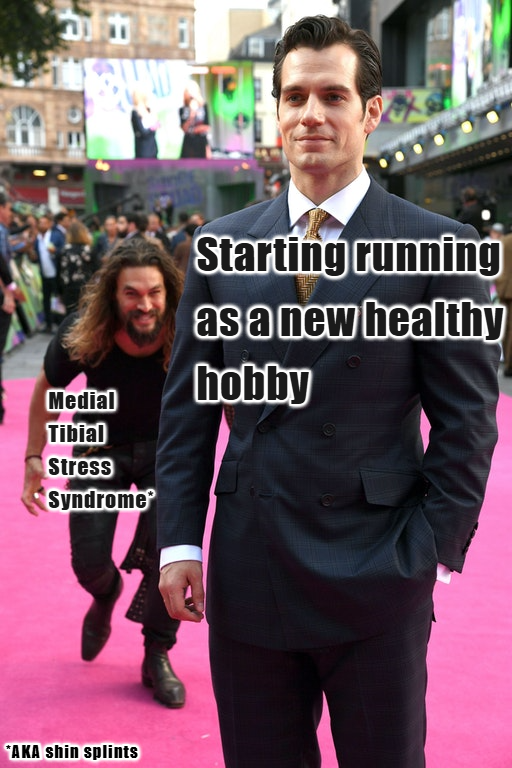
Unfortunately for Joe, despite his best intentions and planning, his body struggled with shin pains and lower back pain. The latter felt similar to a work-related injury when lifting a manhole cover the previous November.
Given Joe’s tall stature, how his pains seem to had ‘restarted’ with running and having stopped his weight training a few months prior, I figured his body was still yet to adapt to the new forces of running that were being exerted through his body.
His big goal was to run consistently without pain for 25mins.
Initially we worked heavily on his lower back and hip muscles with a strengthening and stretching programme. This responded well after 1-2 sessions and Joe found it easier to run so we didn’t adjust much to his running except to rest if needed and ice the shins after. But we moved onto his calfs and shin muscles (the peroneals and tibialis anterior) as the back improved.
After 3 sessions and applying our ‘running stategy’ he was feeling so positive he signed up to a 10km run in Southampton on the 12th October with the family.
Unfortuantely, Joe’s shins flared up 3-4 weeks before the 10K and were still causing him trouble the week of the race. We had to take a very conservative approach to his training to get him through to the finish line.
I’m very happy to report that Joe completed the 10km in a very respectable 56mins with no shin pains and has been continuing his 5kms 2 times per week since.
Joe’s experience is a good example that rehabilitation isn’t always straight forward or easy to predict but being consistent and gracious with yourself can get you over the finish line.
It was a pleasure Joe. Thank you for picking me to help you and hope to hear you crossing many more finishing lines in future!
Thanks for reading.
Until next month…
Motion Forword ⏩⏩
Nathan